Ferrari Luce Opens a New Chapter: Inside Mythical Maranello 🇮🇹
🇩🇰 Du finder den danske version af denne artikel her.
On Location in Maranello, Italy 🇮🇹
In Maranello, Ferrari is about far more than cars. It is a story of heritage, craftsmanship, speed and emotion, built over decades. Now, the Italian marque is taking one of the biggest steps in its history with Ferrari Luce, its first fully electric car.
I would not describe myself as a particular car enthusiast. But even if you do not follow every new model or know the difference between every engine variant, there is something special about Ferrari. It is one of those rare brands that has grown far beyond the product itself.
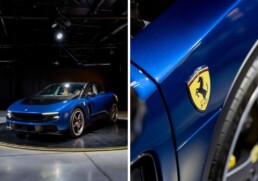
In Ferrari’s historic hometown, we had the exclusive opportunity to meet the team behind a new chapter in the company’s history and get closer to Ferrari Luce, the first fully electric car set to take the Italian legend into an electric future.
“At Ferrari, Tradition and Innovation Go Hand in Hand”
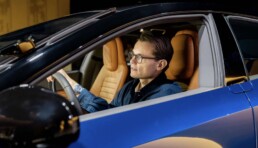
Words by Jon Nedza
Before Looking to the Future, We Must Understand the Past
To understand where Ferrari is heading with Luce, it helps to understand where it came from. Motorsport, Italian design, craftsmanship and emotion are not values invented in a boardroom or created by a marketing department. They have been shaped by decades of victories, ambition and uncompromising work. But before returning to Luce, let’s go back to the beginning.
Ferrari’s history began with Enzo Ferrari, who founded the racing team Scuderia Ferrari in Modena in 1929. Maranello later became the company’s home, and it remains deeply rooted in the brand’s identity today.
On 12 March 1947, the engine of the Ferrari 125 S was started for the first time. It was the first car to carry the Ferrari name, a racing machine powered by a 12-cylinder engine that laid the foundations for a legacy that would unfold on race tracks around the world. Later that same year, the car secured its first Grand Prix victory in Rome. In 1950, Ferrari took part in the inaugural Formula One World Championship. Since then, the Prancing Horse has become one of the most recognisable symbols in motorsport.
It is precisely this combination of motorsport, Italian design, craftsmanship and emotion that makes Ferrari so fascinating. The cars are naturally at the centre of it all, but the story behind them matters just as much. Ferrari does not simply sell transportation. It sells an idea of performance, exclusivity and a distinctive way of life.
The journey began in Copenhagen, aboard a packed Ryanair flight to Bologna. As luck would have it, I found myself seated next to representatives from the leadership and board of Bologna FC. Conversation soon turned to Harald Nielsen, the Danish striker who became a celebrated figure at the Italian club in the 1960s. It was an unexpected connection between Denmark and Bologna, and a reminder that sometimes the best stories begin before you even reach your destination. There were also kind words about Copenhagen, but that is another story.
Ferrari Luce: A New Electric Era
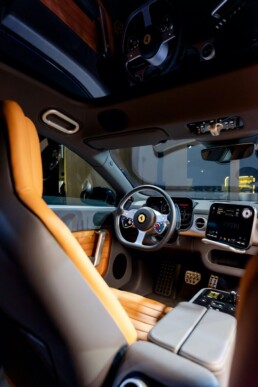
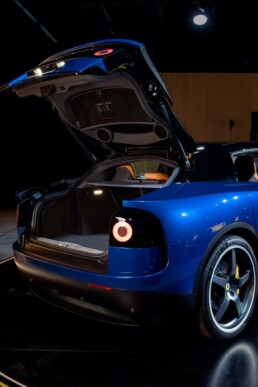
Ferrari Luce represents several historic firsts for the marque. It is Ferrari’s first fully electric car, its first five-seater and a model that places greater emphasis on space and comfort than the classic sports cars most people associate with the name.
That does not mean Ferrari has compromised on performance. Quite the opposite. Luce features four electric motors, one at each wheel, delivering a combined output of more than 1,000 horsepower. That is enough to propel the car from 0 to 100 km/h in around 2.5 seconds, with a top speed exceeding 310 km/h.
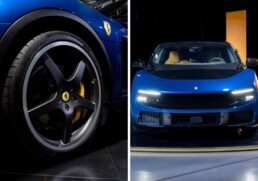
For the design, Ferrari has partnered with LoveFrom, the creative studio founded by former Apple design chief Sir Jony Ive and designer Marc Newson. The result combines clean lines with a mix of physical controls and digital interfaces. It is an approach that stands out at a time when many carmakers have moved almost every function onto large touchscreens.
With Luce, Ferrari is seeking to unite two worlds: the digital future and a more tactile experience, where materials, physical controls and attention to detail still matter.
Ferrari has yet to announce pricing for the Danish market. In Italy, the announced price is around €550,000. (Before taxes and duties.)
The first European deliveries are scheduled for late 2026. The car will be available in several colours, ensuring that personalisation remains an important part of the Ferrari experience.
Behind Closed Doors
Understanding Ferrari Luce is about more than understanding the car itself. It is also about understanding the place and culture from which it comes.
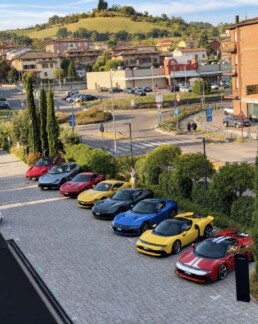
The following 24 hours offered the chance to experience several of Ferrari’s models, go for drives and tour the factory, where the company brings much of its history and future together under one roof.
The site is normally closed to the public, which makes the experience all the more special. Behind the factory gates, thousands of employees work to combine Italian craftsmanship, advanced technology and uncompromising performance. At the end of 2025, Ferrari employed 5,718 people worldwide, the vast majority of them in Italy. The company’s annual report offers a glimpse into the scale of the operation.
Photography was not permitted inside the production areas, so you will have to imagine the rest. Yet gaining access to a world that remains closed to most people highlights something fundamental about Ferrari: tradition and innovation are not opposites. They are two sides of the same story.
Just beside the factory lies Fiorano, Ferrari’s private test track, established in 1972. It remains a vital part of the development process, where cars are tested and refined, and where the connection between the craftsmanship of the factory and the uncompromising demands of motorsport is still very much alive.
Luce Is an Attempt to Expand the Perception of Ferrari
Will Ferrari lose its soul in the shift to electric power? It is the big question. For Ferrari, engine sound and mechanical engineering are about more than technology. They are part of the brand’s emotional DNA. Electrification therefore changes more than the powertrain. It also challenges the very idea of what a Ferrari should be.
Luce is an attempt to broaden that perception. With four doors, five seats and a greater emphasis on comfort, Ferrari is opening the door to a different kind of customer without giving up its pursuit of extreme performance. At the same time, the collaboration with LoveFrom shows that Ferrari is willing to bring in fresh perspectives from outside the automotive world as it shapes its next chapter.
It is too early to conclude whether Luce will be a success or how it will be received by Ferrari’s most traditional customers. But the ambition is clear: electric mobility should not simply be a technical solution. It should feel like a Ferrari.
After 24 hours in Maranello, one thing stands out. Ferrari is a brand that has built its position on staying true to its history while constantly pushing new boundaries.
It is a considerable challenge. And that is precisely what makes Luce interesting, even to those who do not usually follow the automotive world.
Ferrari had no influence on the content of this article.
More from The Global Desk?
Meet the people, companies and brands thinking beyond borders. Explore more stories from The Global Desk.