The Story of Copenhagen’s Golden Weather Girls
🇩🇰 Du finder den danske version af denne artikel her.
If you have walked across City Hall Square in Copenhagen in recent years, you may have noticed two gilded women high above the city, moving in and out of the tower of Richshuset.
Just two years ago, they were brought back to life.
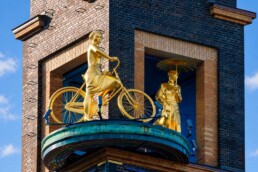
After some 30 years of stillness, the mechanism behind the famous weather girls was restored as part of a wider renovation of Richshuset, the distinctive building opposite Copenhagen City Hall. Today, the two figures once again offer their own take on the weather: the cyclist appears when sunshine is on the way, while the woman with an umbrella and her dog signals rain.
But the story behind these two golden figures is as interesting as the weather they predict.
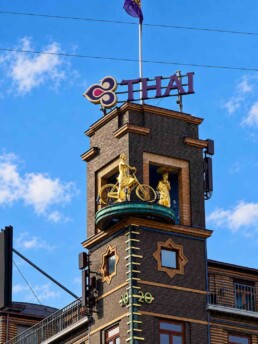
Alongside the large neon thermometer running down the corner of the tower, the figures were designed to form a kind of weather station high above Copenhagen’s City Hall Square.
The weather girls were created by Danish sculptor Einar Utzon-Frank and installed when Richshuset was completed in 1936.
One is the fair-weather girl. Dressed in a summer dress, she appears on her bicycle when the forecast calls for sunshine.
The other is the rain girl, who steps out with an umbrella and her dog when rain is on the way.
Together with the large neon thermometer running down the corner of the tower, the figures were designed as a kind of weather station overlooking City Hall Square.
And this is more than a charming piece of symbolism. The figures actually move according to the weather.
In the early 1990s, however, the mechanism fell silent.
For some three decades, the weather girls remained fixed in place. For a generation of Copenhageners, they became little more than part of the architecture – perhaps without realising that they had once moved with the forecast.
One explanation for their long period of inactivity was that Richshuset no longer had the caretaker who had previously been responsible for operating the mechanism.
As part of the building’s extensive renovation, however, the original mechanism was restored.
This time, the technology was brought up to date. The weather girls are now connected to a modern digital weather station, allowing them to change automatically as the weather changes.
The idea remains much the same as it was in 1936. Only the technology has moved on.
The story behind Richshuset
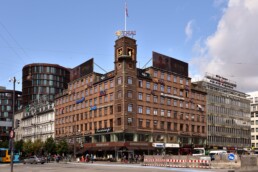
Richshuset itself is almost as interesting as the figures at the top.
The building was designed by architect Alf Cock-Clausen and constructed between 1934 and 1936 as the headquarters of C.F. Rich & Sønner, the company behind the much-loved Danish coffee substitute Rich’s.
At the time, coffee substitutes made from ingredients such as roasted rye and chicory were big business in Denmark, and Rich’s was a household name.
It is from the company that the building takes its name.
Today, Richshuset is best known for its distinctive corner tower, the neon thermometer and, of course, the weather girls. The building is also considered one of Copenhagen’s notable examples of Art Deco architecture.
The Man Behind the Weather Girls
The weather girls were designed by sculptor Einar Utzon-Frank, a professor at the Royal Danish Academy of Fine Arts and a prominent figure in Danish art during the first half of the 20th century.
He was also responsible for several other notable works in Copenhagen, including the equestrian statue of King Christian X at Sankt Annæ Plads.
The weather girls, however, are among his more playful creations.
While most statues simply stand still and invite us to look at them, the two women atop Richshuset have a practical purpose. They tell Copenhageners what the weather has in store.
More from The Global Desk?
Meet the people, companies and brands thinking beyond borders. Explore more stories from The Global Desk.