Ritu Jain of LifeX: “We’re creating more flexible ways to live in the city”
🇩🇰 Du finder den danske version af denne artikel her.
Danish company LifeX did not begin as a business plan, but as a personal frustration.
CEO and co-founder Ritu Jain moved to Denmark to work in tech, where building digital solutions became a natural part of her professional world. But the idea behind LifeX emerged outside the office — through her own experience of trying to settle into a new city.
Over the course of two years in Copenhagen, Jain moved eight times and quickly realised how poorly traditional housing systems are designed for people living internationally or constantly on the move.
Today, that experience has evolved into a company operating across several European cities, offering a more flexible way of living for young professionals.
LifeX sits at the intersection of housing, technology and community, catering to people building careers and lives between cities such as Copenhagen, Berlin and Munich.
At its core is a simpler approach to urban living — one where moving into a home should feel straightforward, accessible and less burdened by traditional barriers.
At the same time, the model challenges more established ideas around renting, ownership and how people choose to live in modern cities.
We met Ritu Jain on Vesterbrogade in Copenhagen over coffee.
“I’m inspired by building things that solve real problems”
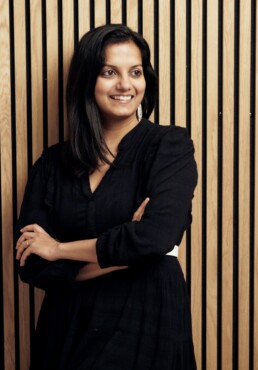
Ritu Jain, CEO & Co-founder, LifeX
“It’s about making the entire housing experience simpler”
Ritu, if you had to explain LifeX in the simplest way possible — are you a housing company or a lifestyle platform?
“You could say we exist somewhere in between the two. The original idea behind LifeX came from a problem I experienced personally.
When you move to a new country, you need more than just a place to stay. You need an address, local registration, a bank account, and at the same time you’re trying to adapt to an entirely new culture. All of that often happens while starting a demanding new job.
That’s why we’ve always approached LifeX from the customer’s perspective. We built it as a tech platform that makes communication, payments and moving in much easier. Ultimately, it’s about simplifying the entire housing experience.
So in simple terms, LifeX is a platform designed to make moving into and living in furnished homes across major cities more seamless.”
About LifeX
LifeX is a network of co-living homes across Europe, originally founded in Copenhagen.
The company was launched in June 2017 by Sune Theodorsen and Ritu Jain.
Who is LifeX created for?
“People like ourselves. We actually started by using the solution ourselves. For three to four years, we lived in the homes we were helping to create.
Today, our members are typically between 25 and 40 years old, but it’s a very broad group. It ranges from teachers and chefs to people in finance or employees at companies such as Deloitte and Novo Nordisk. Others come from startups or international companies.
We have both Danish and international members, with a fairly even balance between men and women.
What they often have in common is that they are moving to a new city and don’t necessarily want to do it alone. Loneliness plays a bigger role than people might think, and a shared living setup can make a real difference. There is also a sense of security in it, we’ve heard from several women, for example, that they feel safer in LifeX than in the private rental market.”
“Loneliness plays a bigger role than one might think, and a co-living setup can make a real difference”

Today LifeX operates in Copenhagen, Aarhus, Berlin, Munich, Oslo and Hamburg. How do you decide which cities to enter, and where does the company stand today?
“Our starting point is Copenhagen. We are a Danish company looking to grow internationally, and that’s what we’ve done in the cities you mentioned.
You could say we’ve largely expanded based on our members’ needs. In the beginning, when people moved on from Copenhagen to a new city, we would often receive emails asking whether we were there as well. These were typically people relocating for new jobs.
So it has really been an organic development, where demand from our own members has helped define where we go next.”
Where have you succeeded?
“We’ve helped thousands of people find a home, and many have built both communities and friendships through LifeX. For us, that in itself is a meaningful story, that we can help provide something as fundamental as a home and a base in everyday life.”
“It’s not our users or members who misunderstand us…”
You’ve previously said it’s a misconception that you take housing out of the market. Where do you feel you are being misunderstood?
“Fortunately, it’s not our users or members who misunderstand us. There is a very fixed idea of how people are ‘supposed’ to live, you either buy or rent, pay a large deposit, and follow quite rigid frameworks.
We are trying to challenge that way of thinking about housing. There are already structural challenges in the housing market and with prices that are not created by us. We are not taking homes out of the market, not at all. We transform existing homes, which are often too large for the average family, and use them differently. People then choose LifeX if they find it attractive, which many do.
It can be about avoiding living alone in a new city, flexibility, or financial reasons. It varies a lot from person to person.”
Is there a lack of political courage?
“It’s perhaps more about clarity than courage. We’ve been here for eight years, and there are political voices that see us as a positive development, while others are more sceptical.
What we are missing are clearer frameworks, so it’s easier to understand what we are operating within. We are not an investment company or a short-term housing concept like Airbnb. We are trying to create more flexible housing solutions, not fewer traditional ones. So clearer rules would actually help everyone.
We would also like to contribute to a broader dialogue on how co-living can be recognised as one of several housing solutions, with a clear framework for everyone to follow.”
“The model works across cities and cultures”
What are your ambitions for the company?
“We want to make LifeX a strong Danish brand with an even greater international presence. We can already see that the model works across cities and cultures, which gives us a clear signal that there is a global need for what we are building.
At the same time, Denmark has a strong international reputation, which has helped us become a trusted brand in new markets. We are also curious to explore even more markets than we are in today.”
Where do you personally find inspiration?
“I’m inspired by building something that solves real problems. For me, it’s about taking something complex and making it simpler. That is really the core idea behind LifeX, especially when it comes to something as fundamental as housing and everyday life in a city.”
More articles like this?
Stay updated on the most exciting stories, tips, and interviews. Sign up for our newsletter and get it all delivered straight to your inbox. Over 60,500 already on the list. We send it once a week!